How Sofa Disassembly Saves Your Sectional When Moving Through Tight Apartment Doorways
Sofa disassembly can make oversized furniture easier to move by removing suitable backs, arms, legs, sectional connectors, or reclining components before transport. The right approach depends on the sofa’s construction, upholstery, internal frame, removable parts, access measurements, hardware, and reassembly needs.
- Measure the doorway before trying to force the sofa through.
- Identify removable sections before taking apart individual pieces.
- Protect upholstery and exposed edges during breakdown.
- Label hardware by component.
- Plan reassembly before transport.
Measure the Exit Before Taking the Sofa Apart
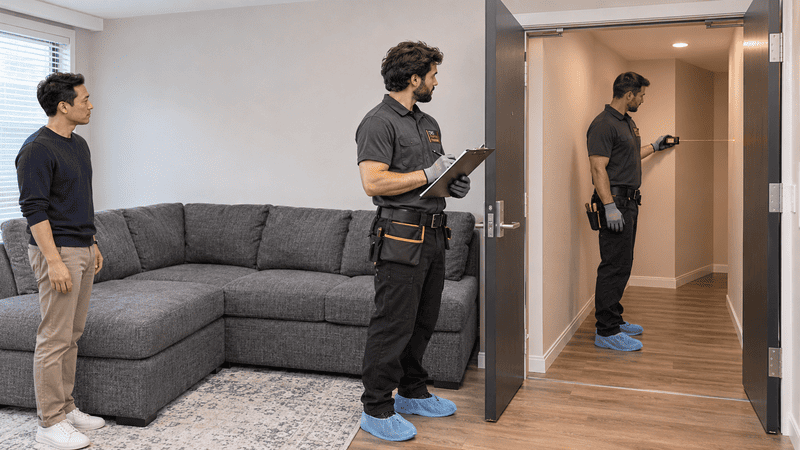
Measure the full exit route before you decide what to remove. A sectional can fit comfortably in your living room and still be too long for the hallway, too deep for a stair turn, or too tall to tilt inside the elevator.
Forcing the sofa through, or turning it again and again, can scrape walls, strain the frame, or tear upholstery. In a Washington, DC, walk-up, the apartment door may clear the sofa, while the first stair landing leaves too little room to pivot.
Professional sofa disassembly starts by finding the tightest point and identifying which removable parts affect clearance. The plan can then focus on reducing the right dimension, protecting exposed sections, and keeping hardware ready for reassembly.
Check the Tightest Point
Measure the clear space you can actually use, not the size listed on a floor plan. Then measure the sofa’s length, depth, and height at its widest or tallest points. After breakdown, check the same dimensions on the largest remaining piece, with room for padding and a secure grip.
In a Maryland high-rise, a low sofa back might clear the elevator door, while the long chaise still won’t fit inside. Removing the legs would lower the chaise, not shorten it. Measuring both the sofa and the route helps you avoid that kind of unnecessary work. It can also show when breakdown alone may not solve the access problem.
| Access point | What to measure | Why it matters |
|---|---|---|
| Apartment doors and building entrances | Clear width and height with the door open; space taken up by handles and trim | The usable opening may be smaller than the door frame. |
| Hallways and corners | Narrowest hall width, ceiling height, and space on both sides of each turn | A piece can clear the door but be too long to swing into the hallway. |
| Stairwells and landings | Clear width between walls and handrails, overhead clearance, and room at each stair turn | A short landing or low ceiling can limit how far the piece can tilt or pivot. |
| Elevators | Door width and height; interior width, depth, and height | A section may clear the elevator doors but leave too little room for them to close. |
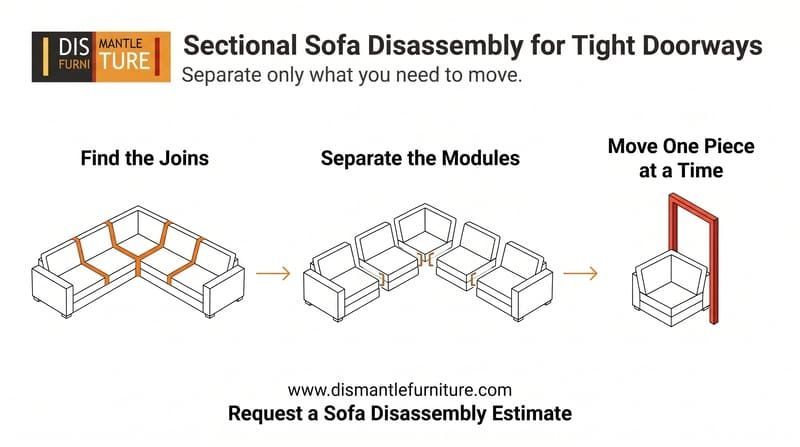
Break Sectionals Down at the Right Connection Points
Start with the joints the manufacturer intended to separate. On some sectionals, releasing the connectors lets you move the chaise, corner unit, and seats as individual pieces. On others, a long section still needs attention because its arms, legs, or back add bulk where the route is tightest.
Sofa disassembly means separating suitable components, organizing their hardware, protecting exposed sections, and preparing the sofa for tight-access moving and later reassembly. It doesn’t mean stripping the sofa down to its frame.
- Chaise and corner units: Check how they join the main sofa. A corner piece can still be deep enough to catch on a stair turn after separation.
- Armless sections and seat modules: Look for the intended release points. Some mechanical connectors lift apart, while others use brackets held by fasteners.
- Back panels, legs, and arms: Remove only parts designed to detach, and only when doing so helps with clearance or handling.
Upholstery seams aren’t reliable guides to what comes apart. Hidden fasteners may sit behind an access flap, while an arm that looks separate may be part of the frame. If a joint resists, stop and check the manufacturer’s instructions rather than pulling the fabric or forcing the connector.
For a sectional with several linked seats, professional sectional sofa disassembly services can help identify which pieces can travel on their own. If the long side clears the door but the return won’t make the turn, L-shaped sofa disassembly services can help assess where to separate the chaise or corner unit.
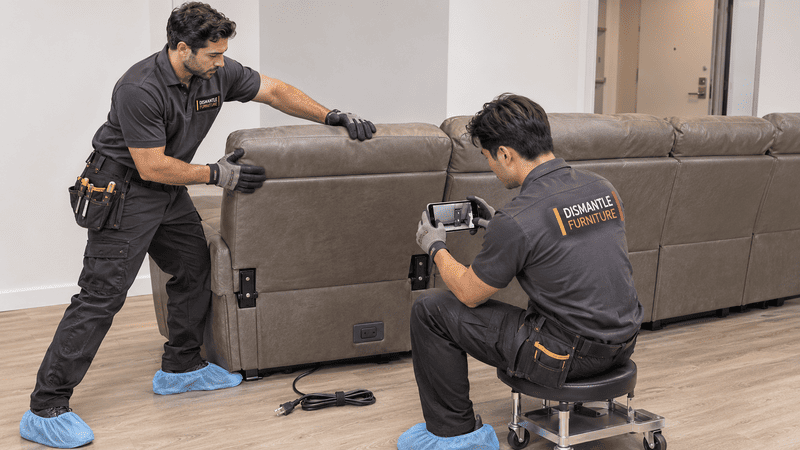
Separate Recliner Components With Extra Care
A reclining sofa requires more care because its seats may contain moving linkages, release cables, or powered parts. A removable back can lower the profile, but that doesn’t mean the footrest, motor, or arm module needs to come off. Follow the manufacturer’s instructions for your model.
- Manual recliners: Check whether the reclining handle uses a cable or a mechanical linkage. Don’t lift by the handle or footrest, or use either as leverage.
- Power recliners: Follow the manufacturer’s shutdown and unplugging instructions. Photograph and label accessible power connectors, control wiring, and cord routes before any permitted disconnection.
- Backs and side modules: Confirm whether the backs or arm modules detach. Keep their hardware separate, and follow the manufacturer’s instructions for securing moving parts before transport.
In a Northern Virginia apartment with a small elevator, removing the backs may provide enough clearance without separating the motors or footrest sections. If a section stays heavy or several seats share wiring or linkages, recliner sofa disassembly services can help assess what can stay intact.
Make a note of any handle that sticks or footrest that already sags. That gives you a record of the sofa’s condition before the move. If the mechanism needs attention beyond breakdown and reassembly, ask about professional recliner repair services as a separate part of the job.
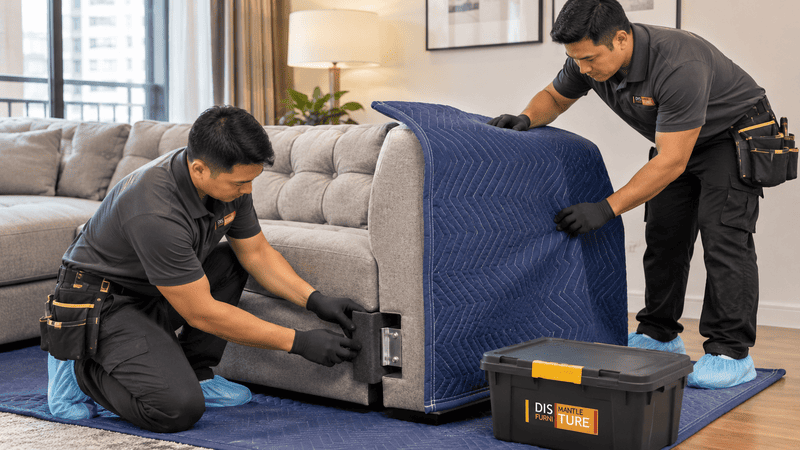
Protect Frames and Upholstery During Breakdown
Smaller sections can reduce the need to twist a sofa around a corner or tilt it sharply on a landing. That can ease strain on wood frames, frame joints, and upholstered arms. Once pieces come apart, though, exposed corners and metal brackets need protection of their own.
- Pad exposed edges. Cover hard corners, metal brackets, and protruding hardware so they don’t snag fabric or rub against another section.
- Choose firm handling points. Support the piece at solid frame points. Don’t pull on upholstery seams, decorative trim, or tufted buttons.
- Wrap for the surface. Use clean, soft protective wrapping against leather and fabric. Avoid placing adhesive tape directly on the upholstery.
- Avoid pressure when staging pieces. Don’t stack a heavy seat on an upholstered arm or tufted back. Keep hard brackets away from finished surfaces.
If a tufted back has to pass close to a handrail, padding the rail side helps, but the crew still needs room to grip and turn the piece. Professional tufted sofa disassembly can help identify suitable handling points and limit unnecessary pressure on buttons, seams, and trim. Disassembly alone doesn’t prevent damage; how the pieces are wrapped, staged, and carried still matters.
How We Handle Tight-Access Sofas
Dismantle Furniture handles sectional sofa disassembly, L-shaped sofa breakdown, tufted sofa disassembly, and recliner separation for residential moves. Our team helps plan access, protect frames and removable parts, and match labeled hardware to each component. We keep the work area orderly and coordinate the breakdown and reassembly plan with residents, movers, landlords, or property managers.
Professional help is worth considering when heavy sections meet a narrow apartment door, tight staircase, small elevator, or sharp hallway turn. A large L-shaped sectional in a Pennsylvania walk-up and a powered recliner in a Delaware high-rise call for different plans. In both cases, checking the route and construction first can reduce guesswork, especially when the furniture needs careful reassembly.

Keep Every Bolt and Connector With Its Section
Keep hardware with the component it came from, not in one bag for the whole sofa. Bolts and screws can look alike even when they differ in length or thread. Missing washers, pins, or connector plates can delay reassembly or leave sections that won’t line up.
- Bag fasteners by part. Keep bolts, screws, and washers for each arm, leg, or back bracket in a labeled bag.
- Match both sides of a joint. Label the sections that meet, then photograph their connector plates, brackets, and pins before removal.
- Keep recliner parts separate. Match power cords and recliner hardware to the seat they belong to, especially when two seats look alike.
Define what “left” and “right” mean on your labels. For example, write “left arm, facing sofa” rather than just “left.” Match each bag to a label on its wrapped component or to a simple inventory. Before the sofa leaves, check that the bags, cords, and loose brackets are all accounted for.

Plan Reassembly Before the Sofa Leaves
Plan how the sofa will go back together before you pack or move any pieces. Check the route into the destination room, then decide where the sofa will sit and which sections need to go in first. A piece that clears the old apartment may face a tighter turn at the new one.
- Record the layout. Take a wide photo that shows the chaise orientation, arm placement, and how the seats meet.
- Capture the details. Photograph connector positions, back alignment, and leg locations. For a power recliner, record the original cable routing so cords don’t end up in the path of moving parts.
- Plan the reassembly sequence. Match section labels to the hardware bags and follow the model’s instructions. Leave enough room to align backs and reach connectors before sliding the sofa into its final spot.
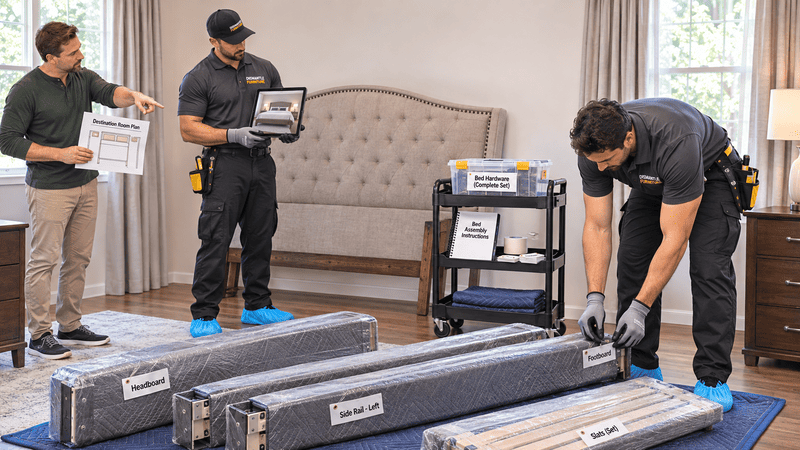
For example, a corner unit may need to enter a narrow living room before the seats that attach to it. Assembling the easy to reach pieces first may block the space you need to turn the largest one. If a bed frame or wardrobe also needs to come apart for the same tight route, furniture disassembly and reassembly services for larger pieces can help you plan that work alongside the sofa.
Mistakes That Make Reassembly Harder
Skipping measurements at either address can lead to forcing a piece through an opening or removing parts that never affected clearance. Excessive force, pulling on upholstery instead of releasing the hardware, and leaving exposed frames unpadded can all create problems that a smaller moving footprint won’t solve.
Mixing fasteners, losing connector hardware, or disconnecting a recliner without taking photos can make it harder to tell what goes where. Even with all the parts in hand, rebuilding in the wrong order can block access to a joint. The less you need to remove, the fewer connections you have to restore.
What Affects the Cost
Pricing depends on the actual sofa, the access at both addresses, and the work you request. Sofa type, size, section count, and the number of removable parts all shape the job. Tufted upholstery, frame construction, complex hardware, and powered or linked reclining components can change how much work the breakdown requires.
Tight stairs and small elevators also affect how small the pieces need to be. Share photos of existing damage, such as a loose arm or bent bracket, so it can be factored into the plan. Clarify whether you need breakdown only or reassembly at the destination, too.
Book Sofa Disassembly for Tight Access
Before moving day, request a sofa disassembly estimate with photos and measurements of your sofa and tightest opening. Dismantle Furniture can help reduce bulky dimensions, protect removable parts, organize hardware, and plan reassembly. We provide professional furniture disassembly services for tight-access moves across Washington, DC, Maryland, Northern Virginia, Delaware, and Pennsylvania.
Frequently Asked Questions
Can a sectional sofa be taken apart for a narrow doorway?
Sectional sofa disassembly can reduce the largest piece’s dimensions when the design allows separation at its connectors.
Can a power recliner sofa be disassembled for a move?
Some models have removable backs or modules, but check the manufacturer’s instructions before disconnecting powered components.
Which sofa parts are usually removable?
Legs, backs, arms, and seat modules may detach, depending on how the manufacturer built the sofa.
How should I organize sofa hardware during a move?
Bag hardware by component, match each bag to a section label, and photograph connector positions before removal.
When should I hire a professional to take apart my sofa?
Consider professional help when sections are heavy, connectors are unclear, or tight turns leave little room to maneuver.

Reconfigure Your Modular Office Layout Flawlessly with Our Professional Cubicle Breakdown and Repair